
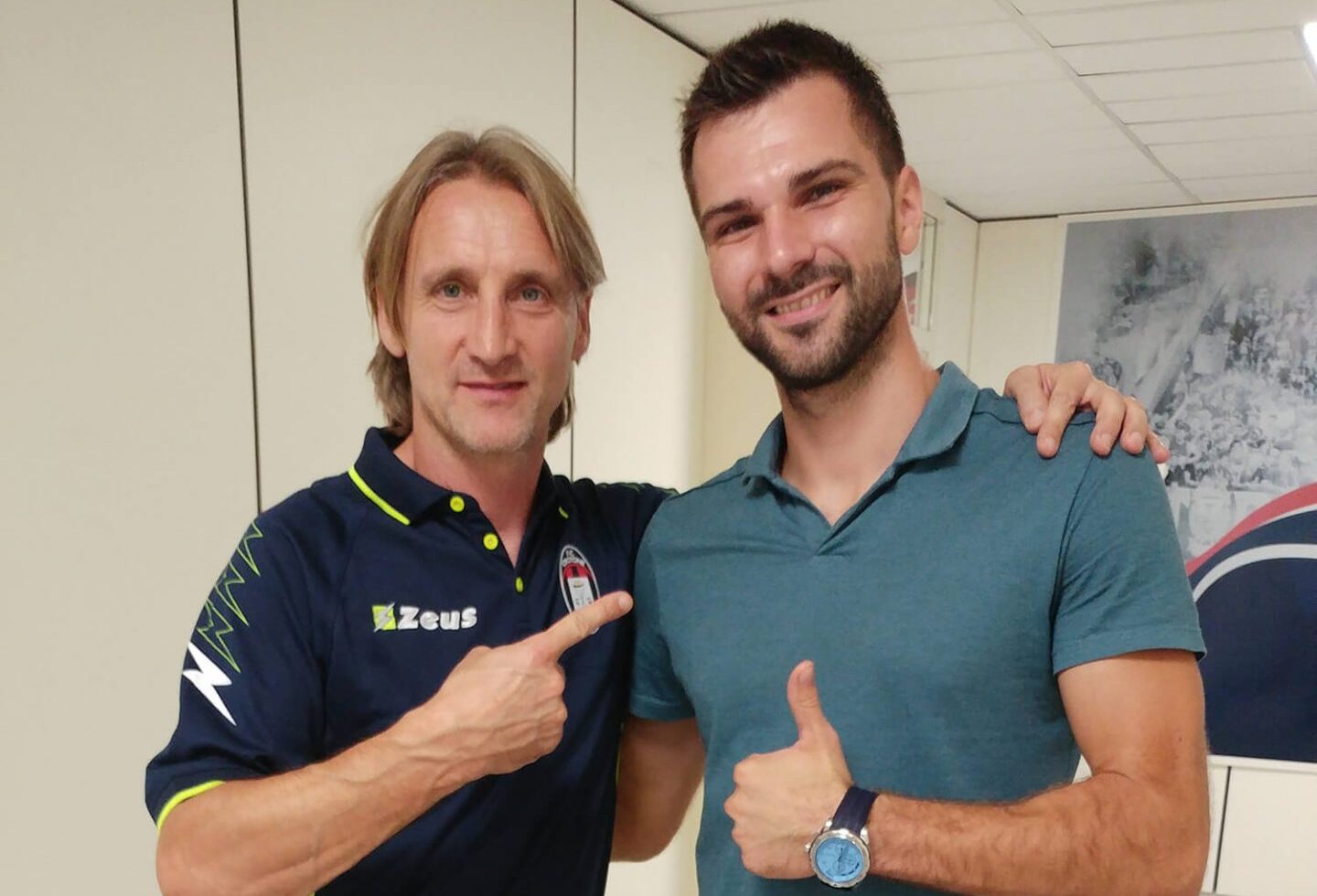
A few days ago, I had the opportunity to visit F.C. Crotone, a football club from the south of Italy that is playing for the second consecutive season in one of the strongest leagues in the world – Serie A. I was a guest of my long-time client, Ante Budimir.
Serie A
Opportunities like this only come a few times during the season, and I am very happy when I have the chance to prepare and see my players in person. Namely, for most of the season, we rely on a whole range of modern technology that helps us bridge the physical distance. Today, fortunately, distance is no longer such an obstacle to high-quality work, even in mental preparation. Given that this is Ante’s fourth season playing abroad, we have already become accustomed to this way of working and are finding the best ways for Ante to be ready for the numerous challenges and the tight match schedule in Serie A.

Who is Davide Nicola, the coach of Crotone?
However, this is not directly a story about Ante, but about the coach of FC Crotone, or as the Italians say, Mister Davide Nicola.
For many, he may be an unknown coach in his mid-40s. A former football player who played as a defender, he spent his entire career playing in Italy, mostly for Serie B clubs, and playing one season in Serie A. After his football career, Nicola ventured into coaching. The success for which the entire Calabria region celebrates him is definitely keeping Crotone in Serie A after taking over the club from Ivan Jurić, who, together with his entire coaching staff and with the help of Ante’s 16 goals in the 2015/2016 season, secured Serie A promotion for the first time.
Certainly a historic success for a small town of about 60,000 inhabitants, which, in terms of surface area and population, is no larger than our Zadar. Many predicted his failure and boasted that this would be Crotone’s first and last season in the 1st league, because “it is easier to enter the 1st league than to stay in it.” There might be some truth to that, but I personally believe that it is an extremely difficult job to both enter and stay in the strongest Italian league.
Getting to know each other and grilling right from the start
As soon as I arrived at the hotel where the Crotone players and staff were staying, Ante threw me into the fire and introduced me to his coach. Thanks Ante, that’s the only way 🙂 To be clear, my knowledge of Italian is at a level where I will understand 70% of what is being said to me, but I can only “cobble together” about 30% on my own. However, I have always loved challenges, so I more or less understood the 3 questions coach Nicola asked me 5 seconds after we met, and I started to answer. Fortunately, the coach was reasonable, realized that it could take a while 🙂 and gave me time to write down my answers for him instead.
The questions seemed very simple: “What specific things do I work on with athletes?”, “Where does it all start?”, and “What do I want to achieve through my work?”
My answers will remain a secret, nor are they that important. What surprised me even more was that a few days later, he stopped me after training, and we managed to agree that we would talk more the next day, this time with Ante as a translator.
Cooperation with a coach – normal or a reason for surprise?

Why was I left surprised? Isn’t a conversation between the head coach and the psychologist of one of the most important players useful? Shouldn’t that be normal? The answer is yes, it is useful and it should be normal… in the West, less frequently in Croatia.
Glory to the exceptions, I have the opportunity, or rather the honor, to cooperate with wonderful coaches. Younger and older, promising, willing to learn, to discover new things, eager for constructive criticism and advice, ready for an interdisciplinary approach to athlete development. With those who put the athlete’s well-being first. Who do everything in the athlete’s best interest and have dedicated their lives to it. They will recognize themselves in this.
On the other hand, there are those others, unready for cooperation, rejecting it, those with a big “I know it all” ego, those who might fear that they will not know something, or those who, due to their own lack of education, reject everything that did not come out of their own head. I believe that this group is in the minority.
By attending conferences and maintaining contact with colleagues who do the same job outside the borders of Croatia, I have come to realize that both groups exist always and everywhere.
I know that in Croatia, there is a larger number of wonderful coaches who are ready to learn and cooperate in the interest of the athlete. I believe, I look for that in coaches, I consciously wear those kinds of “glasses,” and I know that I will then see it in a coach. However, sometimes, as in this case, I am still surprised by the ease with which coaches seek and want constructive advice, an exchange of experience…
Sincere interest and exchange of ideas regarding mental preparation
But to get back to Mister Nicola. It is match day, the second round, Crotone is playing against Hellas Verona today. In the early afternoon, I arrive at the hotel where the players are quarantined until the match, and I meet with the coach and our translator for this occasion, Ante. Once again, I am a bit surprised by the timing, it is match day… but if it suits the coach, it suits me too.
The coach explains to me his settings according to which he trains, his philosophy of training, work, and team management. I listen and remember. He takes out papers and draws for me, sketches, and explains. I join the conversation and explain the same things from my perspective, we talk about intensity, focus, the athlete’s optimal zone of performance…
I am a visual type, so I start drawing graphs too, sketching how I see things and what I practice in my work with athletes. At no point do I have the feeling that the conversation is driven by ego, on two different levels. We mutually, on equal terms, exchange opinions, experiences, ideas, ready to hear each other out, eager to hear each other and learn something new. It becomes funny because just a few days ago, Ante and I talked and worked on the exact same things, just with a different expression and perspective. We end the conversation with the topic of motivation, my favorite…
A pleasant conversation with the coach in which time flew by, and I am sure it won’t be the last. A conversation that makes me fall in love all over again with my job of helping athletes fulfill their maximum potential!
And what if everyone truly worked together, in the same direction?

Mutual cooperation, working on the same things from two different fields, enriching the athlete’s preparation—all of this is possible if the athlete is put first. If we put our own ego aside, if we do not try to appear smart, but if we strive to learn something new, even if it is just a minor detail, then great things happen… then not only do great people exist, but great ideas become achievable!
And for all those who are interested in hearing the rest of the story with the Crotone coach, I recommend coming to our education program for coaches 🙂