
“You’re the best, you’re going to win. Play out of spite, this time you’re beating him! Just watch out for 1)…, 2)…, 3)… And by no means forget 4)… and 5)… Do you feel ready? Come on, come on, you can do it, just relax! Have you relaxed, huh? Come on now!”
“Coaching is the universal language of change and learning.”
The Athlete-Coach Relationship
Communication skills are proving to be increasingly important in conducting the training process, as the speed at which athletes acquire new motor skills depends on their effectiveness.
High-quality adherence to instructions, setting goals during training and competition, and also preventing conflicts within the team largely depend on the mode of communication and the relationship between the coach and the athlete.
It was recently established that the relationship between the coach and the athlete is precisely one of the important factors for developing an athlete’s mental toughness, and therefore it is worth investing in.
Communication
Communication is something that is learned and acquired through experience; some coaches are naturally better at it, while some are still looking for their best approach.
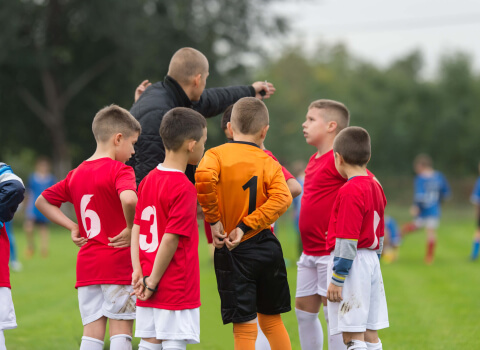
Particularly crucial situations can occur at competitions because the athlete’s focus is narrower then, and there is no opportunity for so many stoppages in play, broad analysis, and corrections. Communication at competitions is precisely something that most coaches can work on.
Tips for Coaches at Competitions:
- Set a common goal (for the whole team) that everyone will strive toward together in the match. The whole is always stronger than the individual.
- In addition to common tasks, assign individual ones as well. By doing so, you reduce the players’ burden of having too much information and simplify the fulfillment of the group goal.
- Let the focus be on what you want to achieve, not on what you want to avoid. The brain accepts information on the principle of an image or mental representation, and in a stressful situation, it can eliminate the negation, leaving exactly what we wanted to avoid (e.g., the advertisement example: “Don’t think about the cake”).
- Give few instructions, a maximum of 2-3, because an athlete’s focus is very narrow in a competition situation.
- If you are giving criticism, use the sandwich method (good-bad-good); it serves to empower the player, especially in youth categories.
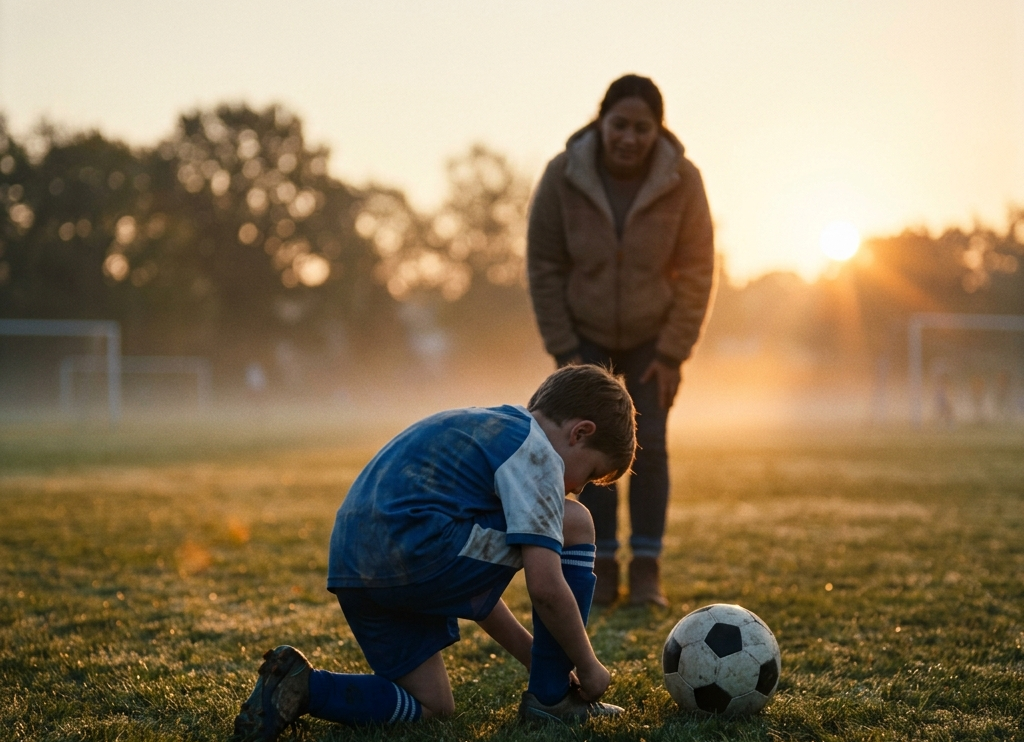
- Avoid false encouragement (“You’re the best, you will win…”) – it can be totally opposite to what the athlete believes. Instead, focus on the athlete’s engagement.
- Immediately before a competition, avoid any questions about form and results. That is absolutely irrelevant and redundant right now. Even if the athlete feels great, they might start thinking about something they cannot change at this moment. Calm your curiosity, avoid asking too many questions, and choose to listen to the athlete instead.
- If it is true, encourage the athlete or the collective by reminding them of the good and difficult training sessions they have completed (the team’s strengths).
- Always prepare motivational speeches – at least the outline of the speech – and avoid the trap of long speeches, as they are ineffective before a competition.
- In team sports, direct the players not to worry about mistakes; they are there for each other to correct them. Encourage players to cheer each other on all the time. Then, even less positive athletes often start using positive self-talk.
- Before a “very important competition,” calm the players down – they are sufficiently aroused and motivated, and there is no need for additional motivation that might cause them to “burn out with desire.” Remind them of what they do well, which leads them to the group goal. Do not change the routine before a “very important competition,” because by doing so, you signal to them that what awaits them is completely different than usual.
- The coach’s job is to first calm themselves down, and then the team (athletes will sense tension and fear).
- Do not focus so much on the opponent, but rather direct the athlete toward their own strengths. We cannot change or control the opponent, nor do we know how prepared the opponent is. The only influence we have is over ourselves, the fulfillment of our own goals, and our own engagement.
- Direct the athlete toward intrinsic motivation by avoiding discussions about results and the promotion of winning or the avoidance of defeat. Instead, focus on praising effort and perseverance. It is precisely engagement over a longer period of time that yields results.
- Formulate a game plan A and a game plan B and check if the player has understood the group task – in a stressful situation, the brain craves certainty. (“Clarity brings confidence!”)
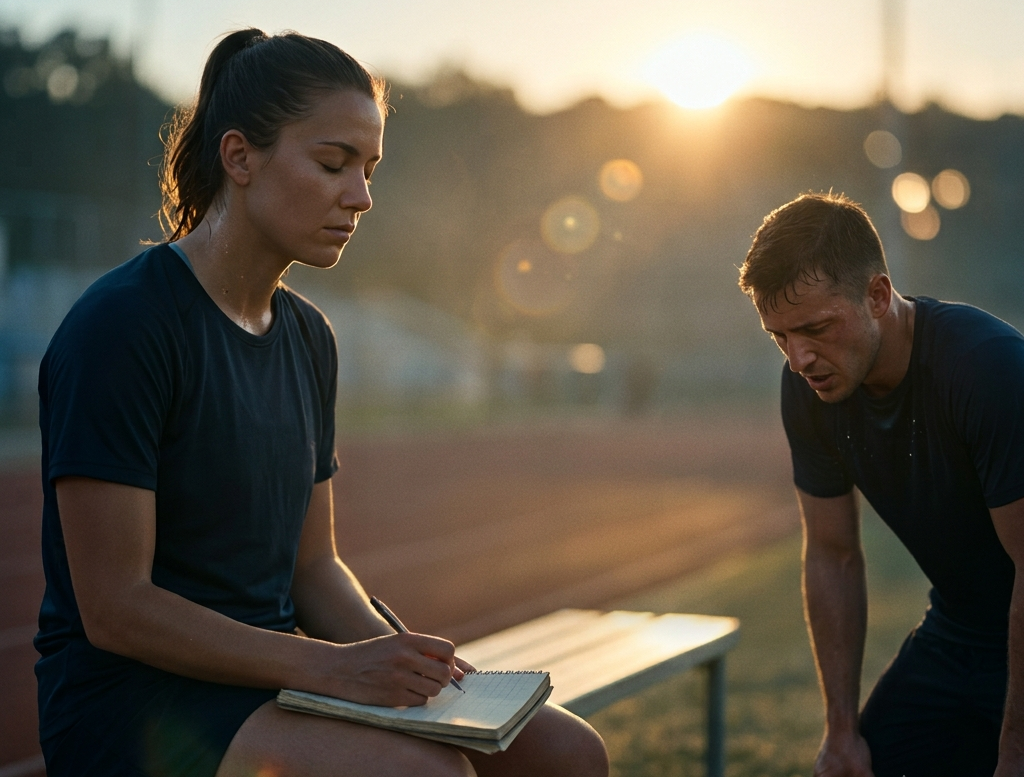
The coach-athlete relationship is a very delicate type of relationship. The coach is an educator, a professional, an authority figure, but equally a close person and a support system. Parents, of course, can help (or hinder) the creation of such a relationship.
The basic rule of communication is: “Learn to listen because even ducks can hear!” Throughout the season, try to hold individual meetings with players of a team sport, because the mere fact that a coach shows concern for an individual raises motivation and confidence. Also, it is easier for the coach to communicate with the individual later because they know them better, know the methods that work for that individual, and know how to motivate them.
Let’s not delude ourselves; a coach’s job is by no means an easily earned piece of bread. On the contrary, a coach frequently performs 4-5 roles in their relationship with an athlete. Consequently, the responsibility is extraordinary, especially when a coach gives a great deal of themselves and wants nothing but the best for their athlete. Communication at competitions is just one small cog that characterizes this relationship. We hope that with these practical guidelines we have made the coach’s job at least a little bit easier.