
When is the right time to start mental training? Our child only plays sports recreationally, why would they need mental training? What are the benefits of mental training for such young children? – These and many other questions are the most common inquiries we receive from parents of young athletes. Given the high level of interest in this topic, you can read our response below.
We view mental training as an integral part of preparation, much like technical-tactical, conditioning, and any other type of training. Many athletes have recognized the need to work on the psychological side of their preparation. However, there are still many athletes, coaches, and parents of young athletes who doubt the importance of mental preparation and give it too little significance, both in daily practices and at competitions.
Why Mental Training for Child Athletes?
- Research shows that nearly 75% of children quit sports after the age of 13.
- Training becomes less fun for children, and competitions bring stress they do not know how to handle.
- Children show much less during competitions than they do at practice—they lack the skills to control tension and concentration.
- Through unsuccessful and stressful competition experiences, children build a poor self-image and develop a lack of self-confidence.
We understand the care and concern regarding working with primary school-aged children, so we want to provide you with an insight into what our experience tells us.
Respecting Individual Differences Among Children
First and foremost, we must take into account that a 10-year-old child, in terms of their abilities and psychophysical development, is not the same as another 10-year-old. In the early stages of athletic development, children vary greatly, and we must respect these differences. Similarly, we cannot assume that every 10-year-old will be cognitively mature enough to follow the demands of working on mental preparation.
Once we get to know the child, we decide together with the parents whether they are mature enough to join the program or if it is better to wait another year or two.
Our experience shows that children can become involved in mental preparation as early as 9–10 years of age. The questions running through most parents’ minds right now are probably: “Isn’t this too early? Why so early?”

Why Mental Training for Primary Schoolers?
Today’s demands in sports – such as introducing children to sports earlier, early sports specialization, and competition systems from the youngest ages – mean that children start training like adult athletes from a very early age. Not to mention school responsibilities and balancing sports and school. We often get the impression that children are pulled into a whirlwind of sports that they do not know how to cope with. They are simply not ready to meet all the demands placed in front of them. This is completely understandable, because no one has had the opportunity to teach them how to handle defeat, how to calm down when they feel performance anxiety, or how to focus.
How many times have we heard phrases at practice like: “Focus! Where is your head at?”
Yet, the child does not know how to focus, does not know how to calm down, and does not know a better way to deal with anxiety. We often see that we have children in front of us, but we act as if they are adults. At the same time, coaches are often the least to blame for this situation. We believe that coaches are doing the best they can with what they know, but the extreme demands of the job, tight practice schedules, and a large number of children prevent them from being able to fully dedicate themselves to each individual child.
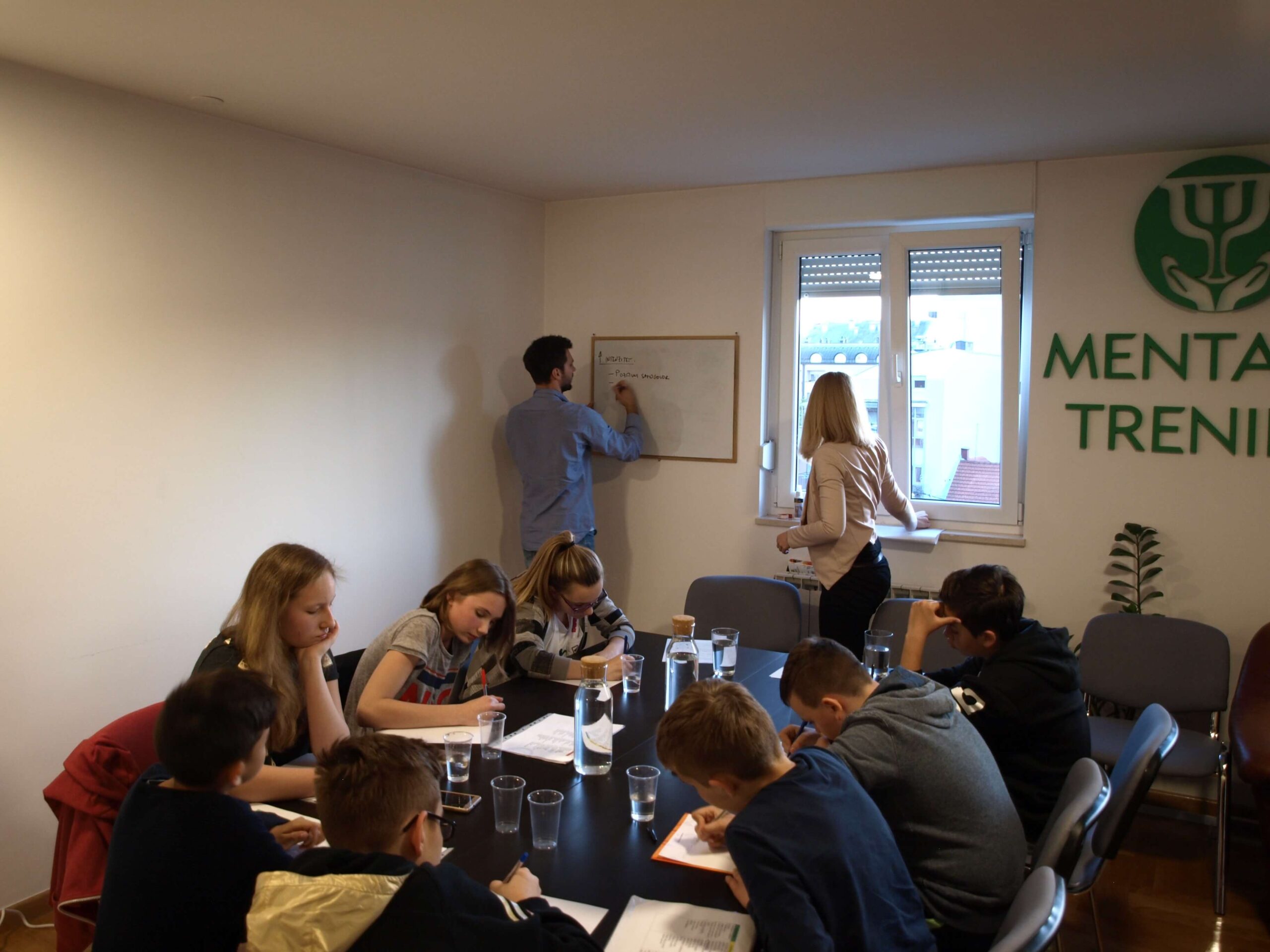
There are certain limitations regarding which aspects of mental preparation are suitable for children and which methods are most appropriate. For this reason, we have also chosen to include children in group mental training, which we currently offer exclusively in cooperation with sports clubs.
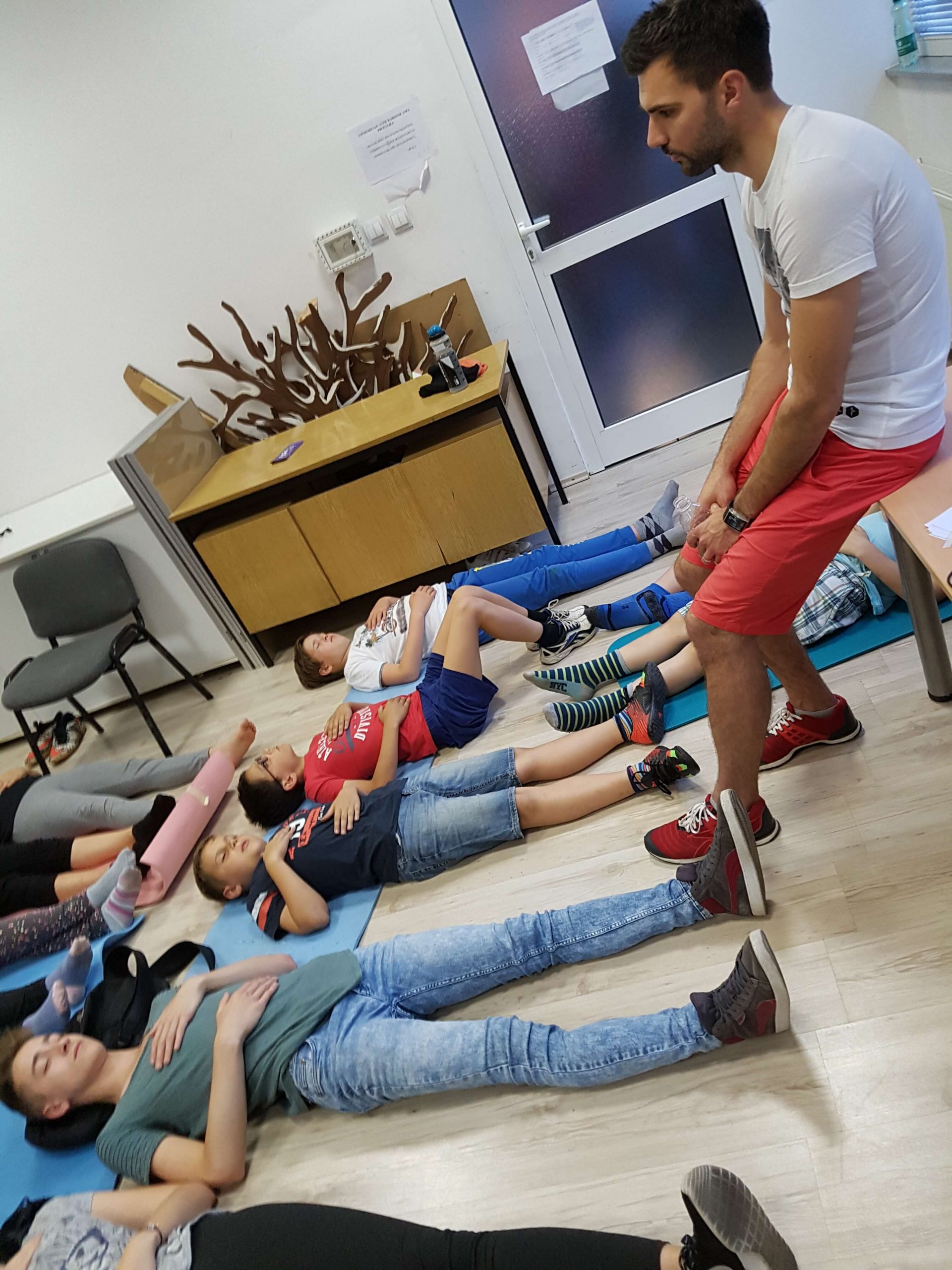
Benefits of Group Mental Training:
- Working in a small group helps children open up and relax faster.
- Children listen to the experiences of other young athletes in the group and realize that similar situations happen to everyone.
- Continuous tracking of athletes within the group for the duration of the mental training.
- Mutual encouragement to work and group support in achieving goals.
Of course, the techniques that are covered and practiced (relaxation methods, goal setting, visualization, learning positive self-talk, and others) are adapted to the age group we are working with. The techniques themselves are not difficult to understand, and continuous group work allows us to track success in adopting mental preparation techniques.
“In My Day, We Didn’t Have That”
Yes, we believe that unfortunately, you didn’t. Perhaps today, the number of mature people in Croatia and the world who engage in sports would be even higher. We are also of the opinion that the demands placed on children today are much greater than they used to be. Times are changing, whether we want to accept it or not.
What Do Children Actually Learn Through Mental Training?
Applicability to School – It always surprises us how many different methods and techniques of mental preparation children manage to apply within a school context.
Focus in Crucial Moments – Children learn to maintain concentration during decisive moments of a competition, thereby achieving better results.
Calmness Under Pressure – They practice ways to achieve calmness during competitions.
Consistency of Motivation – By focusing on well-set goals, children maintain high-quality motivation.
Task-Orientation at Competitions – With well-set goals and a focus on the tasks that help them achieve them, children achieve better results at competitions.
We hope we have brought you at least a little closer to understanding the importance of working on mental preparation as early as primary school. Of course, if you have any questions or would like your child to start mental training, feel free to contact us. We are here to support your children!