

Athletes know their physical, technical, and tactical preparation in detail. Mental training usually stays without a plan, because progress doesn’t show up on a stopwatch. This guide answers what mental training actually covers – three core areas: emotional regulation, motivation, and focus and concentration, each trained with specific techniques, the same way as physical skills.
The value of mental preparation shows most clearly in the closing stages of competition. When fatigue rises and pressure builds, technique and conditioning stop being enough, and that’s when skills like emotional control and a fast reset after a mistake decide the outcome.
In this guide, we’ll walk you through the three pillars of mental preparation: managing emotions, motivation, and focus and concentration.
Emotional regulation in sport
Nerves before competition, anger after a bad referee call, or a drop in mood after a mistake are normal reactions, built into how we experience things. The problem starts when an emotion begins making decisions for you: when anger picks your next move, or fear decides whether you even try.
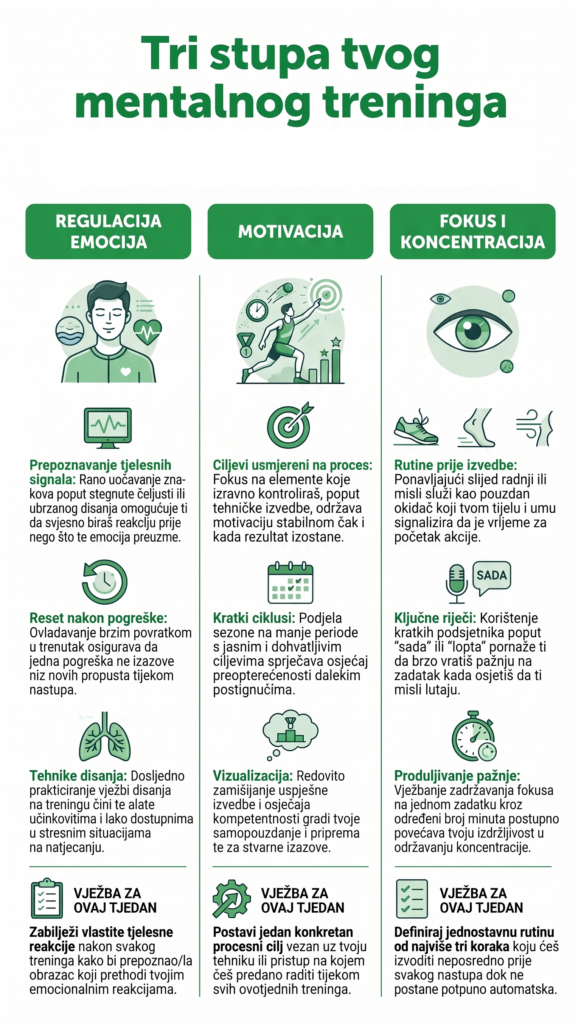
Emotional regulation means recognizing an emotion early enough that you still get to choose how you respond. The emotions themselves stay present; they’re a normal and useful part of competing. Athletes working on emotional regulation practice a few specific skills:
- Physical signals: recognizing a clenched jaw, faster breathing, or a raised pulse before the emotion drives a reaction.
- Anxiety before and during performance: managing the arousal so it carries the performance instead of blocking it.
- Reacting to a mistake: a quick reset after an error, so one mistake doesn’t pull the next two with it.
- Breathing and relaxation techniques: calming breath work practiced in training so it’s available in competition.
- Self-talk: using internal language correctly in moments of frustration and pressure.
This week’s exercise: after every training session, write down one situation where you felt a strong emotion, and what your body was doing a minute before you reacted. After about ten entries, you’ll start seeing your own pattern, and that pattern is a tool for regulating emotion.
Motivation in sport
Motivation tends to drop when it’s tied only to the result, and the result is the least stable thing in sport. When motivation depends on winning, every loss takes away the reason to continue. Motivation tied to what you actually control, progress on a specific skill, for example, stays in place even when the result doesn’t come.
This shows up most in the off-season, when there’s no competition to carry you, and in long stretches of repetition without visible progress, when the same situation gets practiced week after week with no change in outcome. In these stretches, motivation gets built through smaller, measurable goals, using a few techniques mental training relies on for exactly this:
- Process goals: “I’ll practice my penalty technique twice a week” instead of “I’ll score every penalty,” because you control the process every day, while the outcome also depends on others.
- Short cycles: breaking the season into cycles with clear, small goals, so motivation doesn’t rest on one distant target that feels out of reach the moment fatigue sets in.
- Training journal: logging small shifts you’d otherwise miss, because progress you never notice might as well not have happened.
- Visualisation: picturing a future performance and the feeling of competence in a specific situation, not just the win.
This week’s exercise: set one process goal and hold to it through both training and competition.
Focus and concentration
Focus and concentration are related but describe different processes. Focus is directing your attention to one task, object, or action. Concentration is the ability to hold that focus over a longer stretch of time.
Both are skills you train, not innate abilities you either have or don’t. Take, for example, directing your attention to what’s relevant in that moment and setting the rest aside: the crowd, the last mistake, the scoreboard. An athlete with developed focus notices quickly when attention has drifted and brings it back to the task; the distractions themselves don’t disappear.
A few proven methods build focus and concentration:
- Pre-performance routine: a short, repeatable sequence of actions or thoughts that signals to the body and mind that it’s time to act. The complexity doesn’t matter; consistency is what makes it a reliable trigger.
- Cue words/focus points: a short word or phrase (“now,” “ball”) that pulls your attention back to the task the moment concentration slips.
- Extending concentration: exercises where attention holds on one task for a set number of minutes without interruption, extending gradually as attentional endurance grows.
This week’s exercise: define a routine of no more than three steps that you run right before every performance, in training, and in competition, until it becomes automatic.
Frequently asked questions
Can I do this on my own, without a psychologist?
Some steps, like keeping notes or defining a routine, you can do on your own. Once emotions or a drop in motivation start interfering with everyday training, working individually with a licensed sport psychologist speeds up the process, because the approach gets tailored to you instead of following a generic scheme. It also helps to practice the techniques themselves with a sports psychologist first.
How quickly do you see results from mental preparation?
It depends on the skill and how consistently you work on it. In practice, we see the first changes show up within a few weeks of regular work, not after one session.
Is mental preparation different for team and individual sports?
The core principles – emotional regulation, motivation, and focus – stay the same. The difference is in context: team sport adds communication and a role within the group, while individual sport demands more independent handling of pressure, without teammates to lean on.
Conclusion
Mental training, like physical preparation, is built through repetition. You can start with any of the three steps in this guide, without waiting for everything to fall into place at once. That’s how we’ve worked with athletes for over 15 years, from junior club level to Olympic medalists. If you want a structured approach built around your sport, book an info meeting.