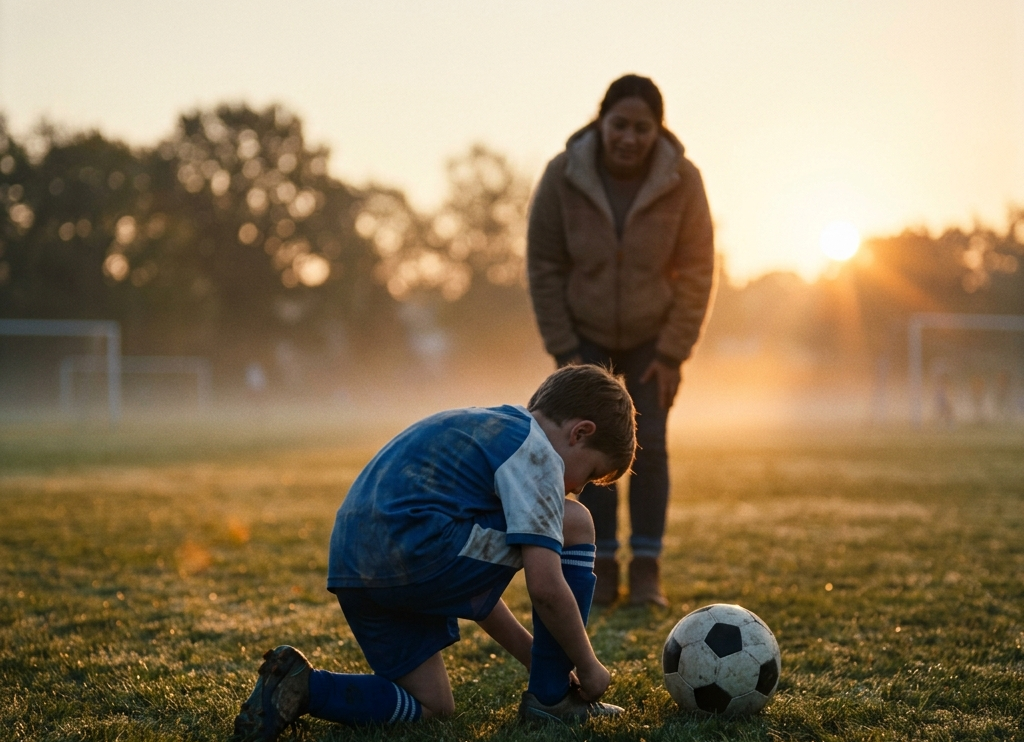


Research shows that sports are vital for the successful development of children. At an early age, a child’s cognitive development is closely linked to motor development. In fact, even intellectual abilities in early childhood are measured indirectly through motor skills tests.

What the statistics say
Despite all the benefits, an increasing number of young children drop out of sports and stop engaging in physical activity every year.
Statistics show that in 2008, 45% of children under the age of 13 played a sport, whereas in 2021, that figure dropped to 37%. Furthermore, depending on the study, 50% to 70% of children quit sports by age 13. The situation among girls is even more disheartening than among boys.
These numbers are the result of an interaction of many factors: educational demands and a virtually non-existent dual career in sports and education, the demands of sports systems—a heavy focus solely on the competitive side of sports, parental expectations and pressure, and a lack of peer support.
Motivate children for sports
To begin with, it is important to know that many behaviors are learned through modeling, which means that children (as well as adults) observe and then imitate the actions and behaviors of those around them.
If you want to be a good role model for your children, you should also engage in some form of physical activity. Children of parents who exercise express a desire to play sports more often and stay in sports longer.
Speaking of good role models, if your child expresses a desire to stop training:
- Suggest that you watch a good sports documentary together or read a sports biography.
- Take them to a sports game, race, or match in the sport your child trains. Your child is more likely to continue playing sports if they look up to a specific athlete.

- Furthermore, some children quit because they do not like competitiveness and do not enjoy competing. In that case, help your child find a recreational form of sports activity.
- Not every child needs to become a professional athlete, but it would certainly be good for them to engage in some form of physical activity.
- Talk to your child. Ask why they want to quit; find out what the problem is. If it is about the coach or teammates, suggest a change of environment (club). If they are overtired, suggest reducing the number of practices. Do not let them give up at the first hurdle and without an explanation.
After all, children in sports learn about responsibility, fulfilling obligations, and time management. They also learn that one should not give up when things get tough, but that sometimes it is necessary to “grit your teeth.” Use this opportunity to explain to your child the life values you want them to understand and adopt. Of course, if you notice that your child is very unhappy and dissatisfied, do not force them to continue. Instead, offer an alternative solution (another sport, another club, another coach).
Communication is the key to everything. Give your child the time and space to explain to you why they want to quit. Do not threaten or intimidate them. If they are truly unhappy, allow them to step away and take a break. And by all means, try to find an alternative form of physical activity for them if they do not continue with their current one

Well-developed motor skills allow children to explore the world, get to know their environment, and maintain focus longer. This also helps them with learning. Research shows that children who play sports have more self-confidence, better time management skills, and are more responsible.
Just as there is a period in life for education, there is also a period in life to start playing sports. BUT, perhaps even more importantly, there is a period in life when life values and healthy habits are adopted. We view sport precisely as a “school for life” because children will adopt many lessons if they start early and stay in sports long enough.